Are Screens Really Ruining Your Sleep? The Answer Might Surprise You
You've heard it a hundred times: put the phone down before bed. Blue light is wrecking your sleep. Screens are the enemy. If you'd just stop scrolling, you'd sleep better. But is that actually true? And if screens aren't the whole story — what is? As a sleep physiologist who has worked with hundreds of adults struggling with insomnia and disrupted sleep, I want to give you a more honest, evidence-based answer. One that stops blaming your devices and starts looking at the bigger picture. A quick note: this post is written specifically for adults. Screen use in children and teenagers is a different conversation with different research behind it — and one I'll address separately.
Kate Banerjee
4/30/20265 min read
The Blue Light Panic — What the Research Actually Says
For years, the message has been clear: the blue-frequency light emitted by phones, tablets, and laptops suppresses melatonin production and shifts your circadian rhythm, making it harder to fall asleep. The advice that followed was equally unambiguous - no screens for at least an hour before bed.
Although that is still partially true, the latest research suggests it’s not as black and white as that..
A comprehensive 2024 meta-analysis published in SLEEP examined the actual impact of pre-bedtime screen use on sleep onset and found that screens delayed sleep onset by just 1 to 9 minutes on average — a statistically modest effect that rarely translates into the catastrophic sleep disruption we've all been warned about (Chiang et al., 2024).
An earlier landmark study by Chang et al. (2015), published in PNAS, did find that light-emitting e-readers used before bed reduced melatonin levels and delayed circadian timing compared to printed books (Chang et al., 2015). But even here, the effect was most pronounced with devices held close to the face at maximum brightness for extended periods.The research suggests that blue light is a factor, but probably not the dominant one most people assume it to be. So what actually matters?
It's Not What You're Watching. It's Why and When and Where.
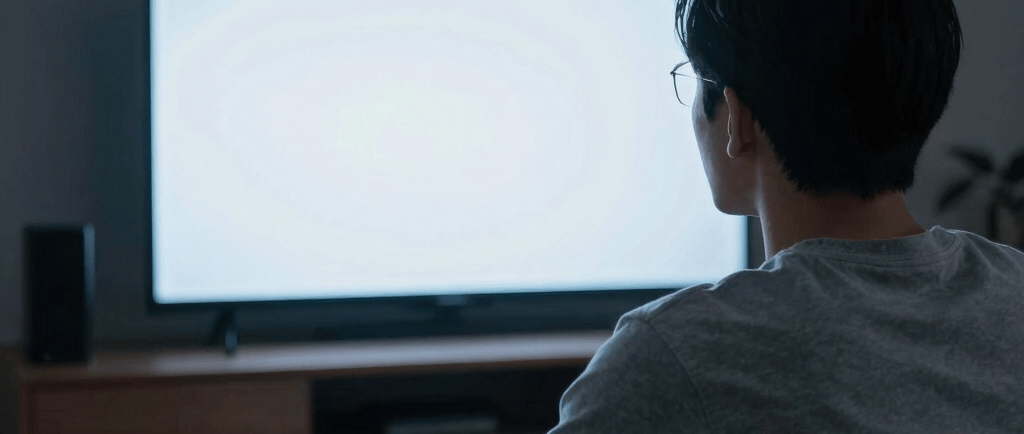
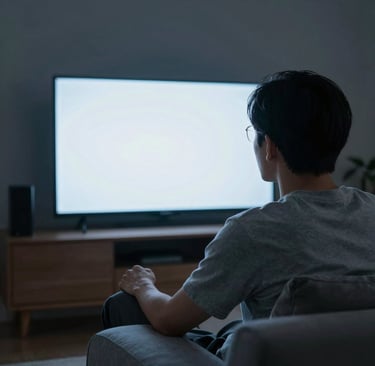
Here's the nuance that gets lost in most "screens are bad" messaging: the content and timing of your screen use matters far more than the light itself.
Watching something stressful, upsetting, or cognitively demanding close to bedtime - the news, a tense work email, a thriller with a cliffhanger ending - activates your nervous system.
Your body responds with cortisol and adrenaline, making it biologically harder to wind down. This has nothing to do with blue light. It's about nervous system arousal, which is one of the three core pillars I work with in every client's sleep plan.
On the other hand, watching something light and enjoyable a comfort show, a gentle documentary, something genuinely entertaining can actually help some people decompress, quieten a busy mind, and ease into sleep more naturally. For people who lie in bed with racing thoughts, this kind of distraction can be genuinely useful. I would challenge anyone who wouldn’t relax watching David Attenborough’s documentaries!
The research backs this up. A 2017 study by Exelmans & Van den Bulck found that how people used their phones before bed (interactive vs. passive, stressful vs. relaxing) predicted sleep quality more reliably than whether they used them (Exelmans & Van den Bulck, 2017).
The Real Problem Nobody's Talking About
If blue light isn't the villain, what is? In my clinical experience, it comes down to one thing that's far simpler - and far harder to fix with a blue light filter:
Staying up past your intended bedtime - self-disciplineThis is where screens become genuinely disruptive to sleep. Not because of the light, but because apps are designed to keep you engaged. Social media, video platforms, games, who series being released in one go on Netflix - they are engineered for "just one more." And every extra hour you spend awake past your natural sleep window has a compounding effect on your sleep drive (the adenosine that builds up during the day to make you sleepy) and your circadian rhythm (your internal body clock).
Research in adults consistently shows the same pattern: it's not the screen itself that shortens sleep - it's the lost hours that come from using it. A study by Exelmans & Van den Bulck (2016) found that among adults, later bedtimes driven by device use were the primary mechanism behind sleep loss, rather than any direct physiological effect of the screens (Exelmans & Van den Bulck, 2016).The message here isn't "avoid screens." It's: know what time you need to wake up, and protect the hours before that. Your consistent wake time is the anchor of your entire sleep-wake system. Shift it by staying up too late and you're not just losing an hour of sleep - you're disrupting the biological processes that govern when you feel sleepy and alert in the first place.
The One Screen Rule I Won't Budge On: Keep Tech Out of the Bedroom
Before I get to practical tips, I want to be direct about something I feel strongly about, both as a clinician and from years of working with adults who can't sleep.
Using screens in bed - scrolling your phone, watching TV, working on a laptop - is genuinely bad for your sleep. Not because of blue light. Because of what it does to your brain's association with the bedroom.
Your brain is a pattern-recognition machine. Every time you lie in bed and do something other than sleep, you're teaching it that bed is a place for wakefulness and activity. Over time, that erodes the automatic drowsiness most people used to feel the moment their head hit the pillow. Instead, your brain wires itself to feel alert there - which is exactly the opposite of what you need. This is the principle of stimulus control, and it's one of the most well-supported behavioural interventions in sleep medicine (Bootzin & Epstein, 2011). The bed should be associated with sleep and sex, and nothing else. Not relaxation, not entertainment, not winding down. Sleep. So while I'm fairly relaxed about screens in general for adults - watching TV before bed in your living room can actually be fine for most - I'd ask you to draw a firm line at the bedroom door. Keep devices out of the bedroom altogether if you can, or at minimum, off the bed and bedside table.
Practical Guidance (That Isn't a Long To-Do List)
I'm not going to give you a 10-step digital detox. That's not how I work. But alongside keeping tech out of the bedroom, here are a few principles that genuinely help:
Use night mode in the evening. Enabling night mode or reducing screen brightness from around 8–9pm is a low-effort way to reduce any potential light impact, even if that impact is modest.
Set a cut-off time - and stick to it. Not because screens are dangerous at a certain hour, but because the addictive pull of scrolling past your intended bedtime is very real. A phone reminder or screen time limit can act as a helpful external cue to stop.
Choose your content deliberately. If you're someone who lies awake with a busy, anxious mind, watching something light and familiar before sleep may actually help more than staring at a dark ceiling. The goal is a calm nervous system - choose content that supports that, and watch it on the sofa.
The Bottom Line
Screens are not inherently the enemy of sleep. The blanket advice to avoid all screen use before bed is an oversimplification that the current evidence doesn't really support - and in some cases, it creates unnecessary anxiety and guilt around something that isn't causing your sleep problems.
What matters is this: what you watch, when you watch it, WHERE you watch it, and whether it's cutting into the sleep time your body needs.
If you've been following all the "good sleep hygiene" advice - including the no-screens rule - and you're still not sleeping well, I'd gently suggest your sleep problems may be rooted somewhere else entirely. Anxiety around sleep, a dysregulated circadian rhythm, or a depleted sleep drive are often the real culprits.
Struggling with sleep despite doing "everything right"? Get in touch for a free 15 minute discovery call with Kate.
NoumZzz
Expert guidance for better sleep and wellness.
Contact:
Support
Email: kate@noumzzz.com
WA: +973 35513131
© 2024. All rights reserved.
Phone: +973 35513131